Review: The Better Angels of Our Nature (draft)
When I was in the 9th grade, my social studies teacher gave a presentation titled “How to find good ideas” that had a lasting impact on my thinking and interests. A large portion of it was centered on books, encouraging me to read books like Sapiens, 1984, and The Gulag Archipelago, among others.1 However, his single top recommendation, Steven Pinker’s The Better Angels of Our Nature, had escaped my attention until now. More than seven years later, I finally gave it a go and can report that it assuredly deserves the glowing praise of my teacher (as well as the five stars given to it by Gwern).
The core thesis of Better Angels is simple: violence has been in a steady decline throughout history, despite many people's intuition to the contrary. Pinker claims that this trend is driven by five historical forces: the Leviathan, gentle commerce, feminization, cosmopolitanism, and the Escalator of Reason. More on these later.
Better Angels is one of the most thorough and comprehensive books I’ve ever read. If you disagree with the book, you definitely cannot fault it for leaving out or misinterpreting data or neglecting certain angles of looking at the trends. Still, Pinker makes some assumptions that influence his perception and interpretation of the data. In this post, I'll zoom in on three of them:
- Should we measure violence in absolute numbers or as a fraction of the world population?
- Are humans peaceful when living in the state of nature?
- Is the moral circle actually expanding?
#Should we measure violence in absolute numbers or as a fraction of the world population?
One of the core tenets behind Pinker’s optimistic interpretation of violence data is his claim that violence should be measured in terms of the likelihood that a random member of the society is harmed, rather than in terms of absolute numbers. …
If you have read Solzhenitsyn’s The Gulag Archipelago, you wouldn’t be at fault for contesting this assumption. Consider the following excerpt from The Gulag Archipelago:2
Up until 1905, the death penalty was an exceptional measure in Russia. For a period of thirty years-from 1876 to 1904 [...], 486 people were executed; in other words, about seventeen people per year for the whole country. (This figure includes executions of ordinary, nonpolitical criminals!) During the years of the first revolution (1905) and its suppression, the number of executions rocketed upward, astounding Russian imaginations, calling forth tears from Tolstoi and indignation from Korolenko and many, many others: from 1905 through 1908 about 2,200 persons were executed-forty-five a month. This, as Tagantsev said, was an epidemic of executions. It came to an abrupt end.
[...]
If we are to judge by official documents, capital punishment was restored in all its force in June, 1918. No, it was not "restored"; instead, a new era of executions was inaugurated. If one takes the view that Latsis 3 is not deliberately understating the real figures but simply lacks complete information, and that the Revtribunals carried on approximately the same amount of judicial work as the Cheka performed in an extrajudicial way, one concludes that in the twenty central provinces of Russia in a period of sixteen months (June, 1918, to October, 1919) more than sixteen thousand persons were shot, which is to say more than one thousand a month.
[...]
The Yezhov men said that during those two years of 1937 and 1938 a half-million "political prisoners" had been shot throughout the Soviet Union, and 480,000 blatnye—habitual thieves—in addition. [...] How improbable are these figures? Taking into consideration that the mass executions went on not for two full years but only for a year and a half, we would have to assume (under Article 58—in other words, the politicals alone) an average of 28,000 executions per month in that period. [...] It is even an understatement! (According to other sources, 1,700,000 had been shot by January 1, 1939.)
And all of this happened ahead of the second world war, which directly caused … deaths! And Russia was far from alone in this—similar atrocities took place in China, Germany, Cambodia, and many other places! How, then, can one claim that violence declined throughout this horrific period?
Pinker argues that hunter-gatherer societies managed to outdo those atrocities. Consider the following plot:
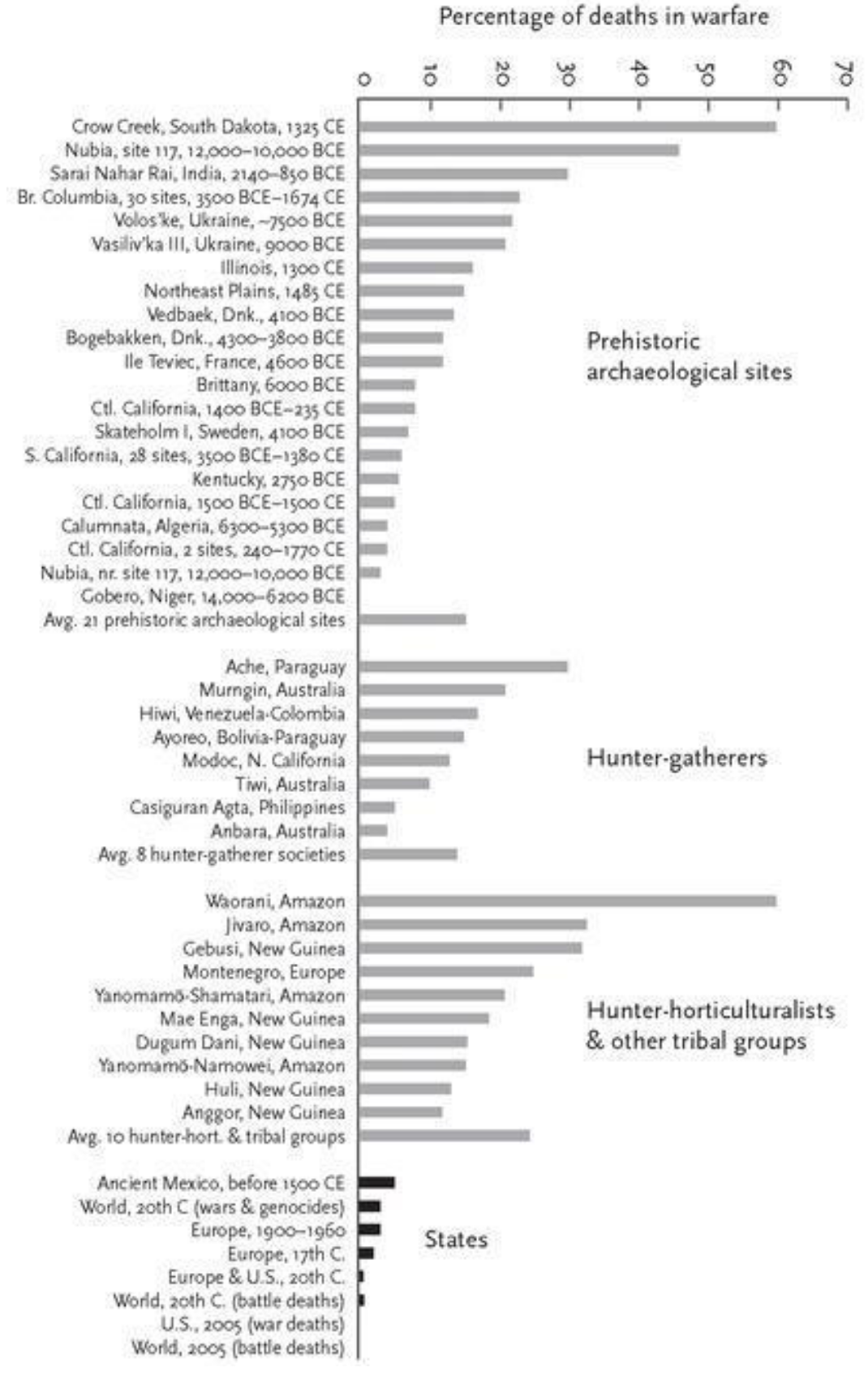
To make things more concrete, let's lay out some of the numbers here. 2005 was one of the US's worst years in decades, with the Americans participating in wars in both Iraq and Afghanistan. Together, these two wars killed 945 Americans, amounting to 0.04% of American deaths in that year. Even when throwing in domestic homicides, we still get a figure of just 0.08%. In the world as a whole, 0.03% of deaths were directly caused by political violence (war, terrorism, genocide, and killings by warlords and militias) that year.
Contrast this with the hunter-gatherers from 14,000 BCE to 1770 CE (displayed in the first group of bars on the plot above): the average percentage of deaths from warfare approaches 15%! And now consider that this figure leaves out all other kinds of violent conflicts that didn't lead to deaths, which have also been declining throughout history.
Not so fast, though. The world population didn't hit 10 million people until somewhere between 4000 and 3000 BCE. In contrast, World War II alone killed 70-85 million people! Are we really justified in ignoring absolute numbers even in the face of this comparison?
People's intuitions here will probably depend on their views toward negative utilitarianism. For a negative utilitarian, it should be hard to accept a world where the absolute population increases tenfold and the proportion of people suffering from violence simultaneously decreases twofold, meaning a fivefold increase in the absolute number of people suffering from violence.3 The negative utilitarian viewpoint is clearly untenable for most of us in the limit: would you really prevent the creation of a million happy lives if a single person had to suffer as a byproduct? However, the conclusion that it's justified to create billions of people who suffer if the total fraction of sufferers goes down even slightly also seems repugnant.
Pinker himself argues against the negative utilitarian argument as follows:
In one frame of mind, one could say that a person who is tortured or killed suffers to the same degree regardless of how many other people meet such a fate, so it is the sum of these sufferings that should engage our sympathy and our analytic attention. But in another frame of mind, one could reason that part of the bargain of being alive is that one takes a chance at dying a premature or painful death, be it from violence, accident, or disease. So the number of people in a given time and place who enjoy full lives has to be counted as a moral good, against which we calibrate the moral bad of the number who are victims of violence. Another way of expressing this frame of mind is to ask, “If I were one of the people who were alive in a particular era, what would be the chances that I would be a victim of violence?”
This basically bogs down to the argument that a society with a lower rate of suffering from violence is better from the veil of ignorance perspective and therefore more desirable, regardless of the total number of people in that world. ...
#Are humans peaceful when living in the state of nature?
Knowing the violence rates of hunter-gatherer societies discussed above, it seems obvious that people aren't peaceful in the state of nature. However, maybe all of that violence occurred in conflicts between different tribes and hunter-gatherers would have been peaceful if they didn't have to fight for territory and resources?
Given Pinker's optimistic outlook on violence, one might think that he also takes a positive view on human nature. He definitely does to some extent, but in the age-old debate on whether a human being under anarchy is a gentle savage, as Rousseau would say, or a selfish brute, as Hobbes might say, Pinker takes the side of Hobbes. Pinker's actual view is more nuanced, of course: he believes that humans have inherently aggressive tendencies that can be kept in check with a well-functioning leviathan, but also many better angels.4 Violence is declining not because human nature has become more peaceful, but because we've developed better institutions and norms that constrain our violent impulses and promote the moral ones.
The view that a leviathan is required to bring out the best in human nature remains contested. Consider Rutger Bregman's article The real Lord of the Flies: what happened when six boys were shipwrecked for 15 months: when real schoolboys get stuck on an island for months, things turn out very differently from Golding's Lord of the Flies! The accident occurred in 1977, when six boys were shipwrecked on a deserted island after catching a storm on a fishing trip. ...
There are larger tribes who have been portrayed as being similarly peaceful. Some of them have inspired whole books: The Semai: A Nonviolent People of Malaya for the Semai people, The Harmless People for the !Kung, and Never in Anger for the Eskimos. These tribes do indeed tend to avoid war, but even so, their homicide rates are still far higher than those in the modern world:
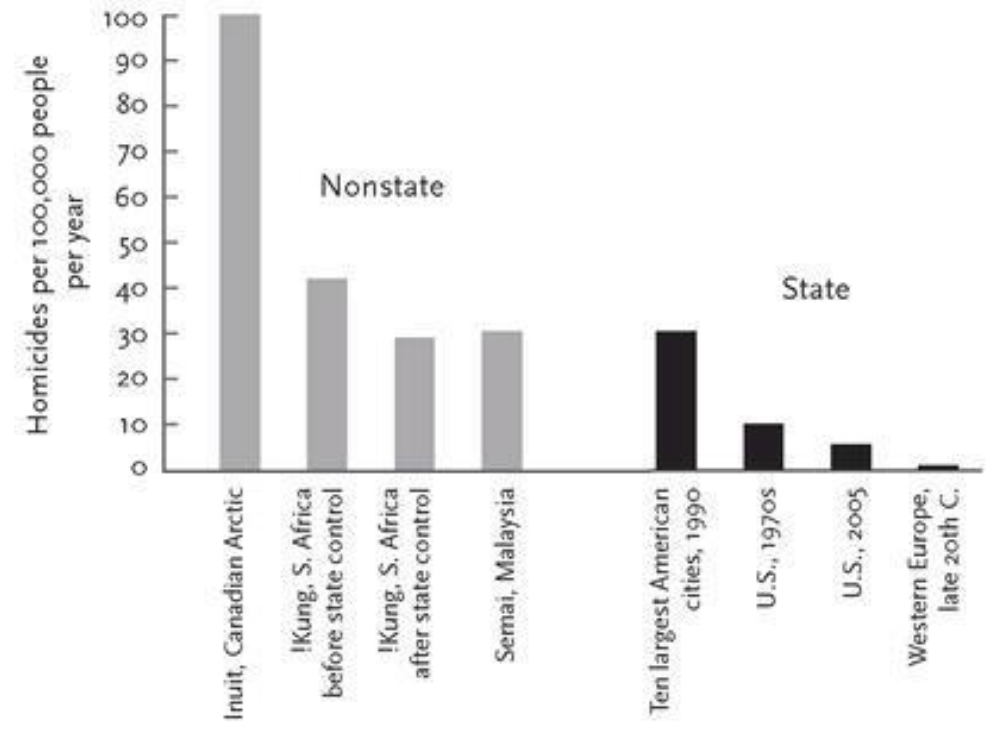
Note that the murder rate of the !Kung went down by a third after their territory had been brought under the control of the Botswana government, as the Leviathan theory would predict. Where does this murder rate come from if not wars, and why were the shipwrecked boys different?
Much of human violence is cowardly violence: for example, a group of men patrolling a territory may ambush a man from another community who happens to be isolated from his group, analogously to lethal chimpanzee raids. The group of shipwrecked boys had just six members—perhaps there were no incentives for them to form lopsided coalitions, given that losing even one member of the group would have had a strong negative influence on their chance of survival. Or perhaps they just happened to be a statistical outlier—after all, their survival constitutes a selection effect that makes us more likely to have heard of them compared to other isolated groups who got into fights and perished.
/ conclusion /
#Why is violence declining?
Let's take it as a given for now that some state intervention is needed to constrain the uglier side of human nature. We've had states for a long while—why, then, has violence continued to decline, and why did this trend accelerate in the second half of the 20th century?
Pinker explores several hypotheses, focusing on the Kantian triangle of democracy, trade, and intergovernmental organizations.5 In short, the decline in violence seems to be tightly correlated with an increased prevalence of democracy, an increased openness to global trade, and increasingly effective intergovernmental organizations. The triangle gets its name from Kant's essay "Perpetual Peace," where he discussed democracy and intergovernmental organizations in length. However, maybe there's a single latent variable that explains both the Kantian triangle and the decrease in violence?
Pinker suggests that this latent variable is the advance in information propagation devices. The first major decrease in violence came during the Humanitarian Revolution in the 17th and 18th centuries, coinciding with ballooning publishing and literacy rates, as well as increased opportunities for travel and science. Similarly, the second half of the 20th century was the advent of TV, computers, widespread jet travel, telecommunications, and satellites, and saw a rapid expansion of science and higher education. There was even an explosion in book publishing: from 1960 to 2000, the annual number of books published in the US increased almost fivefold.
Information propagation devices contribute to all five pacifying forces. A connected and educated populace is much less likely to hold superstitious or ... views about other members of the society, enabling feminization and cosmopolitanism. Books and films encourage us to take the viewpoints of people very much unlike ourselves, contributing to the Escalator of Reason. Finally, quicker communication and increased mobility increases opportunities for commerce, and faster movement of information makes for more efficient states.
#Is the moral circle actually expanding?
The preceding sections bring us to a view in which human nature isn't perfect, but we've gradually become better at constraining our violent impulses and promoting the better angels. Is this entirely the result of improved institutions, or has the moral circle also been expanding, as effective altruists often claim?
Pinker takes the view that ...
While it's clear that morality has become more synonymous with the well-being of sentient beings over time, one can take the cynical viewpoint that this change has been driven by economic conditions rather than by ... Some facts favoring this view include:
- Hindu and Buddhist vegetarianism is often seen as a consequence of the ... of these religions. Pinker offers an alternative explanation, claiming that ...
- The abolition of serfdom and slavery occurred independently in multiple parts of the world at a similar time after the Industrial Revolution. For example, Russia wasn't under British pressure to put an end to serfdom in the 1860s. This suggests that the reason behind the abolition may have been the declining economic value of slaves, rather than moral progress.
#The better angels
Much of this review has been rather gloomy, so let's end on a positive note. ...
#Have the core trends held up since 2011?
https://www.lesswrong.com/posts/4CkqSpkwA9pLjkmz7/have-americans-become-less-violent-since-1980
When planning out this review, I considered focusing the post on whether the trends in violence have held up since the book's publication. Given the ongoing wars in Ukraine and Palestine and unrest elsewhere, one would certainly be forgiven for thinking that the trends have reversed and the world is becoming more violent again. Upon reflection, I decided that this would be a bad idea: given that Pinker focuses on time scales spanning thousands of years, judging the book based on events from the past 14 years feels uncharitable and would feed into recency bias that already plagues us without my contribution. With these reservations in mind, I'll give a brief account of the developments since 2011 for completeness.
#Some miscellaneous facts
Pinker’s book was exceptionally dense and no short review can do it full justice. To provide a glimpse of the topics that I wasn’t able to cover in the review, I’ll mention some miscellaneous facts from the book that I found interesting:
- A bonkers psychology result: Apparently, the difference between the cultural norms of northern and southern Americans is so large that calling someone an asshole has measurably different psychological consequences on these groups. Cohen et al. (1996) studied University of Michigan students raised in the North or South in a setting where someone bumped into each participant right before what they thought would be the actual experiment and called them an asshole. They found that Southerners showed elevated cortisol and testosterone, exhibited more aggressive responses, and had heightened cognitive accessibility to aggression-related concepts. I wonder whether this replicates. Pinker interprets this "culture of honor" as a reason behind the south of the US being significantly more violent than the north.
- Another important psychology result described in the book that I hadn't heard of before is Shotland and Straw (1976). In this study, participants overheard an argument between a man and woman that escalated to physical violence. When the woman was heard to say "I don't know you," participants were ... times more likely to intervene compared to when they heard "I don't know why I ever married you!"
- During Soviet time, abortion was readily available but contraception was allocated centrally and thus in short supply, so former Soviet countries had outlier abortion rates for a while. The rates seem to have normalized by now.
- On terrorism: "In every year but 1995 and 2001, more Americans were killed by lightning, deer, peanut allergies, bee stings, and ignition or melting of nightware than by terrorist attacks. The risk is so low that even minor measures to avoid them can increase the risk of dying. Gigerenzer has estimated that in the year after 9/11, 1500 Americans died in car accidents bc they chose to drive in fear of planes." This doesn't mean that we should entirely discard concerns about terrorism, but provides useful perspective.
- The depth of Pinker's work is demonstrated by the fact that this is, as far as I can remember, the first non-fiction book by a foreign author I've read that references more than one Estonian researcher. The two lucky ones are Rein Taagepera, who features in the book for his work on ..., and Jaak Panksepp, for ...
Footnotes
-
Not all of the recommendations were home runs—e.g., I don’t share his obsession with Kafka—, but the presentation was nevertheless hugely influential. ↩
-
From chapter 11 of volume I. I recommend reading the chapter in full, the book is available online for free—to avoid this blog post from ballooning to a length more appropriate to a book, I had to compress the quotes a lot, losing much of their emotional force in the process. ↩
-
This is an arbitrary example that isn't representative of the actual changes compared to the hunter-gatherer era. The absolute number of violent deaths in a normal year is plausibly smaller now than it was in a hunter-gatherer world with 10 million people: the 0.03% of deaths caused by political violence in 2005 adds up to 16,000 people, while if you suppose that one in 40 hunter-gatherers died in any given year in a world of 10 million, we get 15% of violent deaths out of 250,000 total, which is 37,500 people. However, human population was lower than 10 million for most of human history and it isn't fair to compare the hunter-gatherer data to modern data without correcting for major wars, so the actual difference is likely smaller or reversed. Nevertheless, I was very surprised that the absolute number of violent deaths in a year might be lower in a world of 8 billion people than it was in a world of 10 million people—that's certainly a strong argument in favor of Pinker's thesis! ↩
-
Chapter 8 zooms in on the former, chapter 9 on the latter. ↩
-
I was surprised to encounter Kant here: it doesn't feel like he's known for his contributions to political philosophy, but it turns out that he's written two highly influential essays on the subject, Toward Perpetual Peace and Idea for a Universal History with a Cosmopolitan Purpose. ↩